Sunday, 16 September 2012

VATA

VATA is in the AIR!!!


Fall is coming around the corner this change is also represented in the Vata Dosha. As the temperature drop the wind starts blowing and the leaves on the trees starting drying and changing colour these aspects represent the elements of Vata.

Qualities of Vata:Cold, light, dry, irregular, rough, moving, quick, changeable

Vata is known as the King of the dosha because it represents movement. If you are dominant in this dosha you will tend to always be on the go, with an energetic and creative mind. As long as Vata is in balanced you will lively, enthusiastic and a lean body.

Vata's love excitement and new experiences. They are quick to anger and to forgive. When Vata is unbalanced they are prone to worry and have anxiety and sleeplessness.

TO help balance Vata make choices that bring warmth, stability, consistency and balance.
Going to bed by 10pm and waking at 6am.
Routine 
Avoid being cold as well as eating warm cooked foods ( a frozen berry shake will keep Vata cold all morning).
Touch is very grounding book a massage, do self massage every day(abhyanga massage),
do calming activities walk in nature, meditation, listen to relaxing music.


Favour richer foods : nuts, 
sweet heavy fruit: banana's , mangoes, coconut. 
Avoid eating dried fruit, to help digestion sauté fruits,
Heat your veggies: Asparagus, beets, carrots, 
eaten with ghee (indian butter) brocoli, peas, cauliflower, zucchini and  sweet potato
Beans can aggravate Vata so avoid except: tofu and mung been dahl 
Spices that pacify Vata include cardamom, cumin, ginger, cinnamon, salt, cloves, mustard seed, basil, asafetida, cilantro, fennel, oregano, sage, tarragon, thyme, and black pepper.

Sunday, 9 September 2012

NADI what does it mean?


You might have though because my name is Nadine that is why this blog is called Nadi Body wellness but when chosing a name for a blog you want to make it fit and also represent the subject. 
The subject has never been about me but the journey.
I have been completely obsessed by the Chakra system for quite some time. The subject is so deep and yet I can't seem to get enough knowledge and information about it. It is one of my passions. I've always though that I would have the name chakra in the name until I opened the book 

Product Details


The page I opened it was a chapter on the Nadis in the body and it all made sense!
Yes! 


Here is some info on the Nadi


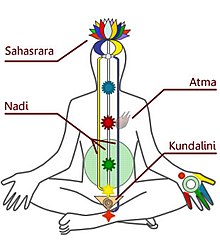
Nāḍi (literally "river", here in the sense "tube, pipe") are the channels through which, in traditional Indian medicine and spiritual science, the energies of the subtle body are said to flow. They connect at special points of intensity called chakras.


An early version of the nadi system is mentioned in the Chandogya Upanishad, which says:
"A hundred and one are the arteries of the heart, one of them leads up to the crown of the head. Going upward through that, one becomes immortal." (CU 8.6.6)[1]
One website states:
"Nadis are not nerves but rather channels for the flow of consciousness. The literal meaning of nadi is 'flow'. Just as the negative and positive forces of electricity flow through complex circuits, in the same way, prana shako (vital force) and manas shako (mental force) flow through every part of our body via these nadis. According to the tantras there are 72,000 or more such channels or networks through which the stimuli flow like an electric current from one point to another."[2]
The word "Nadis" can actually be correctly pronounced as "NaRdi", with R+d loosely pronounced together. In normal biological reference, a "Nardi" can be translated into "Nerve" in English. However, in Yogic, and specifically in Kundalini Yoga reference, a "Nardi" can be thought of as a channel (not an anatomical structure). In regard to Kundalini Yoga, there are three of these "Nardis". "Irda", "Pingala", and "Sushumna". "IRda" (again, R+d spoken just like in "NaRdi" - the effort is made by the tip of the tongue, it curls up, pointing backwards, then lashes out springing forward to lay flat)is lies to the left of the spine, whereas "Pingala" is to the right side of the spine, mirroring the "IRda". Sushumna runs along the spinal cord in the center, through the seven chakras, "Mooladhaar" at the base, and "Sahasrar" at the top (or crown)of the head. It is at the base of this "Sushumna" where the "Kundalini" lies coiled in three and a half coils, in a dormant or sleeping state.

Functions and Activities

Nadis are thought to carry a life force energy known as prana in Sanskrit, or qi in Chinese-based systems. In particular prana (active) is supposed to circulate inside Pingala, while apana (passive) is supposed to circulate inside Ida. Inside Sushumna is supposed to circulate kundalini when awakened.[3] The Ida and Pingala nadis are often seen as referring to the two hemispheres of the brain. Pingala is the extroverted (Active), solar nadi, and corresponds to the right hand side of the body and the left hand side of the brain. Ida is the introverted, lunar nadi, and corresponds to the left hand side of the body and the right hand side of the brain (crossing occurs in the optical chiasma). These nadis are also said to have an extrasensory function, playing a part in empathic and instinctive responses. The two nadis are believed to be stimulated through different practices, including Pranayama, which involves alternate breathing through left and right nostrils, which would alternately stimulate respectively the left and right sides of the brain. The word nadi comes from the Sanskrit root nad meaning "channel", "stream", or "flow". The rhythmical breathing and special breathing techniques are supposed to influence the flow of these nadis or energetic currents. According to this kind of interpretation (which is the Yoga interpretation) the breathing techniques will purify and develop these two energetic currents and will lead to breathing special exercises whose goal is to awake kundalini. Among 7 Nadi Chakras in our body. Of the seven, four are in the trunk of the body, two in the head- and there is one in the neck. Chakra is the power center associated with the subtle body of man. Each chakra is ruled by an incarnation of Goddess Parashakti.

This info was taken from Wikipedia

Have a great day
Nadine Robichaud

[edit]


[edit]